Martingale Strategy Explained: Doubling Bets and Ruin Risk
Martingale strategy explained with doubling tables, streak odds and table limits, plus why it fails in games with a house edge.
A betting system can produce frequent winning sessions without being profitable. The martingale strategy doubles the stake after each loss, aiming to recover earlier losses with a single win, but it doesn't overcome a house edge. In a hypothetical even-money sequence, a player can risk an increasingly large amount merely to finish one base unit ahead. That imbalance makes martingale better understood as risk compression, not a method for creating an advantage.
Table of Contents
- What the Martingale Strategy Is and Why It Looks Safe
- How Stakes Double After Each Loss
- Applying the Doubling Table to a Crash Round
- Table Limits and Streaks That End the Run
- Why a House Edge Cannot Be Beaten by Changing Stakes
- Capped Martingale and Other Progressions Compared
- How Loss Chasing Turns a Progression Into Escalation
- Set Your Limits Before Using Any Progression
What the Martingale Strategy Is and Why It Looks Safe
The martingale strategy is a betting progression in which the stake doubles after every loss and returns to its starting size after a win. On an even-money bet, a successful recovery earns exactly one base unit, provided the player can fund every required stake.
Consider a hypothetical sequence with a 1-unit base bet. The player loses 1 unit, then loses a 2-unit bet, then wins a 4-unit bet. The final bet returns 8 units including the stake, leaving a net profit of 1 unit after all wagers are accounted for.
The progression resembles a ladder whose rungs each cost twice as much as the previous rung. The early steps look manageable, while the money required to continue rises much faster than the intended profit.
Why successful recoveries feel convincing
A player who repeatedly finishes a sequence ahead may conclude that patience makes the system reliable. But the visible outcome, a small winning balance, doesn't describe the money that had to remain available during the sequence.
A 2024 Scientific American analysis indexed by PubMed explains that martingale can ruin gamblers and contrasts it with the Kelly criterion. That contrast matters because a recovery rule isn't evidence that a favorable betting opportunity exists.
Practical distinction: A progression can explain what stake comes next without establishing whether that stake is worth placing.
Unlimited-bankroll reasoning and casino play answer different questions. Real players face finite budgets, maximum bets, and interruptions that can prevent completion of the assumed recovery. Reading the stake table therefore means identifying the point where continuation becomes impossible, not merely checking what happens if a win arrives.
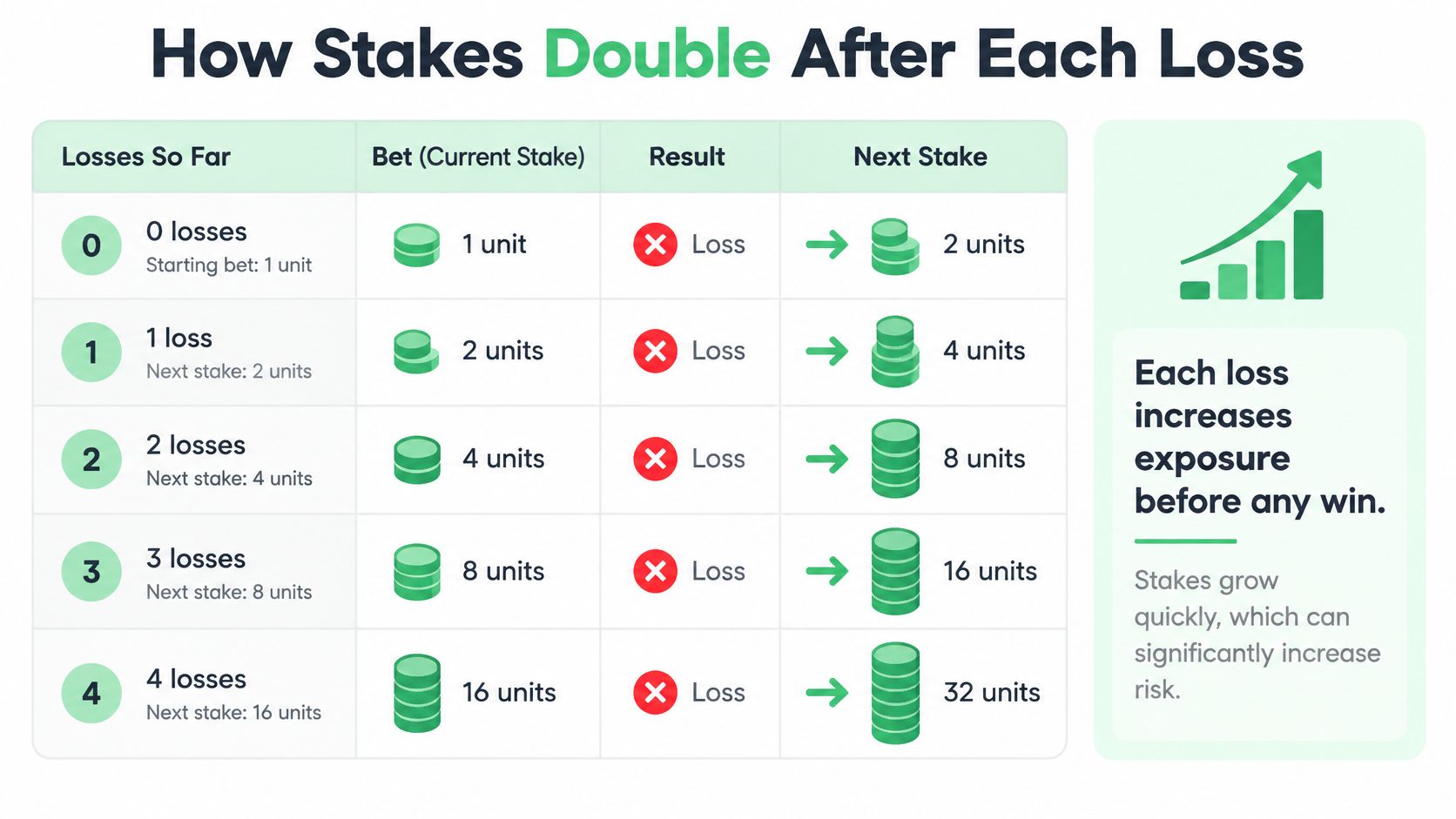
How Stakes Double After Each Loss
Stake and loss totals after each consecutive loss
The following is a hypothetical even-money model with a 1-unit base, full-stake losses, and no fees.
| Losses in a row | Next stake (units) | Total lost so far (units) | Net if the next bet wins |
|---|---|---|---|
| 0 | 1 | 0 | +1 |
| 1 | 2 | 1 | +1 |
| 2 | 4 | 3 | +1 |
| 3 | 8 | 7 | +1 |
| 4 | 16 | 15 | +1 |
| 5 | 32 | 31 | +1 |
| 6 | 64 | 63 | +1 |
| 7 | 128 | 127 | +1 |
| 8 | 256 | 255 | +1 |
| 9 | 512 | 511 | +1 |
| 10 | 1,024 | 1,023 | +1 |
Each row describes a funding requirement, not an expected outcome. The profit column stays unchanged because the winning stake exceeds all accumulated losses by exactly the base bet.
After a hypothetical ten consecutive losses, the player needs a 1,024-unit wager to pursue a 1-unit net profit. The previous 1,023 units are already lost; they aren't part of the money available to fund that wager.
The calculation behind the progression
For a base stake b and n consecutive losses:
- Next stake: b × 2ⁿ.
- Accumulated loss: b × (2ⁿ − 1).
- Funds required before the next attempt: accumulated loss plus the next stake.
That last distinction is easy to miss. A player calculating only the largest wager understates the starting money needed to survive the preceding losses and still place it.
The operating routine is simple:
- Start at the base stake.
- Double after a loss, provided the next bet remains within every preselected limit.
- Continue only within the permitted sequence.
- Reset after a win, rather than retaining the enlarged stake.
The algebra can extend indefinitely. A funded betting sequence can't. The model also assumes an even-money net payout: changing the payout changes whether a doubled winning wager covers prior losses.
A stake table is therefore most useful as a liability schedule. It records what the player has already lost and what must still be committed, rather than presenting each larger bet as an isolated chance to recover.
Applying the Doubling Table to a Crash Round
A crash-game progression depends on the chosen cash-out target and the round's settlement rules. If the round ends before the target is reached, the wager loses. Auto cash-out can set a target such as 2×, but it does not change the chance of reaching that multiplier.
At a 2× target, a successful wager returns twice its stake, including the original stake. That makes doubling capable of recovering prior losses after a win at the target. At a 1.5× target, the return is smaller relative to the stake, so doubling does not automatically recover the accumulated losses. The payout multiple and the progression must be evaluated together.
These are model calculations, not specifications for every crash game. Aviator, JetX, Spaceman, and Aviatrix may differ in cash-out settings and settlement rules. Check each game's published terms before applying a staking table.
What Provably Fair Checks Cover
Where a game uses a commitment-and-reveal process, provably fair verification lets players check whether a revealed outcome matches the committed inputs and published calculation. The check concerns the recorded outcome; it does not supply a signal for choosing the next cash-out target.
The crash session simulator lets readers explore modeled session outcomes. Hold the target constant and track losing runs alongside successful cash-outs. A sequence with many small recoveries can still end in a large loss when a run exceeds the available bankroll or another preset limit.
Before using a progression, check the game's published RTP, target-multiplier probabilities, maximum stakes, and payout restrictions. Rapid rounds can compress decision time, so set a stopping rule before play begins.
Table Limits and Streaks That End the Run
With a hypothetical 100-unit table maximum, a player starting at 1 unit cannot place the required 128-unit wager after seven consecutive losses. The run ends at the cutoff, with the cumulative loss shown in the table.
Cutoff points for a hypothetical 1-unit martingale at different table maximums
| Table maximum (units) | Straight losses that end the run | Total lost by cutoff (units) |
|---|---|---|
| 100 | 7 | 127 |
| 500 | 9 | 511 |
| 1,000 | 10 | 1,023 |
| 10,000 | 14 | 16,383 |
These are calculated examples, not advertised casino limits. Each cutoff occurs when the next doubled stake exceeds the hypothetical maximum.
A streak probability needs a starting point
For an illustrative independent-spin roulette model, assume a red win probability of 18/37 and a loss probability of 19/37. The chance of a specified run of consecutive losses is the loss probability raised to the run length.
Under those assumptions, the calculated chances are approximately:
- Seven losses: 0.94%.
- Nine losses: 0.25%.
- Ten losses: 0.13%.
- Fourteen losses: 0.009%.
Each figure describes a streak beginning at a specified point, rather than the chance of encountering one across an entire gambling history.
A rare event per attempt can become a material exposure when a player repeatedly creates opportunities for it to occur.
A higher maximum permits more losses before the forced stop and raises the amount exposed at that endpoint. Whether a player can fund the sequence depends on both the casino accepting the next stake and enough uncommitted money remaining to place it. A previously accepted wager guarantees neither.
Why a House Edge Cannot Be Beaten by Changing Stakes
A larger stake changes the amount at risk, not the sign of a negative expected return. When each available wager has a negative expectation conditional on the information available before betting, choosing its size from past results doesn't create a positive edge.
In the illustrative single-zero roulette model, the expected net result on an even-money red bet is 18/37 minus 19/37, or −1/37 of the stake. That's approximately a 2.70% house edge. The arithmetic scales with the stake rather than disappearing when the stake increases.

What the simulation establishes, and what it doesn't
The Crashmath Labs Monte Carlo simulation README reports a 99.8% ruin probability for classic martingale in a tested continuous-game scenario with a 3% house edge, alongside median survival of 412 rounds and 100% mean maximum drawdown. These are reported simulation outputs, not independently verified results or universal forecasts for casino players.
This article didn't run that simulation. Its bankroll, stake rules, stopping conditions, and definition of ruin must be independently checked before applying its outputs to another setting.
The established arithmetic and the simulation have different roles. Arithmetic explains why changing stakes can't reverse the expected loss; simulation explores how a specified betting policy behaves within a particular scenario.
Risk compression: Frequent small successful sessions can coexist with exposure to an infrequent loss large enough to outweigh them.
For crash games, the explanation of what 97% RTP means helps separate theoretical return from an individual's session result. A useful progression assessment measures the chance of reaching a target before a defined failure boundary, rather than counting winning sessions alone.
Capped Martingale and Other Progressions Compared
Common progressions compared on the same criteria
| Progression | Stake after a loss | Worst-case exposure | Main risk |
|---|---|---|---|
| Flat betting | Same stake every bet | Grows with the number of losing bets | Long losing runs still drain the bankroll |
| Classic martingale | Doubles after each loss | No ceiling in theory; constrained by maximum bet or bankroll | A funding or betting limit prevents recovery |
| Capped martingale, hypothetical four-loss cap | Doubles until the cap, then stops | 15 units per run from a 1-unit base; largest bet 8 units | The predetermined loss remains substantial relative to the target |
| Fibonacci | Adds the previous two stakes | Grows more slowly than doubling along a losing sequence | Negative expectation and long losing runs remain |
A capped martingale makes the stopping point explicit. In the hypothetical example, stakes of 1, 2, 4, and 8 units expose the player to a maximum sequence loss of 15 units.
That is a known worst case, not automatically a low-risk arrangement. Affordability depends on whether the player can absorb the full loss without replenishing the budget or changing the cap.
Different sizing rules, different obligations
Flat betting doesn't seek complete recovery through the next wager. That makes the stake requirement easier to audit, although a player can still accumulate substantial losses by continuing for too long.
A Fibonacci progression increases stakes more slowly along a losing run, but its recovery behavior depends on the precise reset and step-back rules. The name alone doesn't specify a complete system, and a single win needn't restore the balance.
Classic martingale makes a stronger promise within its idealized payoff model: the next successful doubled bet completes recovery. Its funding requirement is the price of that promise.
The useful comparison is therefore loss capacity, not apparent winning frequency. A player assessing any progression should identify the largest permitted bet, the aggregate loss at the stop, and whether the rule permits immediate restarting.
A per-run cap can become misleading if the player treats each restart as a fresh budget. Session and deposit controls need to cover the combined exposure, not merely the loss assigned to one sequence.
How Loss Chasing Turns a Progression Into Escalation
Loss chasing begins when recovering earlier losses becomes the reason for placing the next wager. A formal doubling rule can make that decision feel disciplined even when the player is becoming less willing to accept the session's actual result.
A peer-reviewed online eCasino study published in Scientific Reports found that gamblers increased their next bets after losses, with the strongest effect following small, affordable immediate losses, and that the pattern persisted over longer sessions. The practical implication is that escalation needn't begin with a dramatic financial setback.
Warning signs and corresponding controls
- Increasing stakes automatically after losses: Establish a maximum session loss that overrides the progression.
- Extending play to get back to even: Set a stopping time and require a cooling-off period before another session.
- Borrowing or adding unplanned funds: Use a deposit cap and exclude credit or borrowed money from the gambling budget.
- Tracking only the next wager: Maintain a running record of cumulative losses and remaining permitted exposure.
- Rebetting without reconsideration: Disable rapid re-bet features where available and pause before changing stakes.
A run of successful recoveries can reinforce confidence because the player repeatedly observes the desired ending. The missing observation is the unresolved sequence that reaches its stopping boundary.
Fast crash rounds shorten the interval between those decisions. A player who hasn't established controls beforehand may repeatedly increase exposure before reviewing the cumulative amount.
A cap helps only when the player accepts the resulting loss rather than overriding it. Anyone recognizing persistent chasing, concealment, or pressure to borrow should pause gambling and contact a local gambling-support service or qualified health professional.
Set Your Limits Before Using Any Progression
Limits should define when gambling stops, not how another deposit becomes justified. The routine below turns a vague intention to stay in control into a written funding boundary.
- Set an affordable total budget. Exclude money needed for bills, savings commitments, and debt payments. Borrowing must not become a continuation option.
- Write the complete stake sequence. Record each wager, cumulative losses, and the maximum permitted losing run.
- Check the game's actual restrictions. Compare the largest planned wager with its maximum bet and check payout limits that might prevent the modeled recovery.
- Activate account controls. Set a session stop-loss and deposit limit before play, rather than relying on a decision made under pressure.
- Choose the loss that triggers a break. Record the stopping condition in advance and prohibit an immediate restart intended to reverse it.
- Test assumptions without wagering. Use a spreadsheet or an independent-round simulator with stated odds, bankroll, payout, and stopping rules. Outputs should describe modeled possibilities, never predictions.
Check the game and the operator separately
Game documentation should establish RTP, multiplier behavior, and cash-out mechanics. Operator terms should establish availability, identity-verification requirements, payment restrictions, bonus eligibility, and withdrawal conditions; none should be inferred from a game's name or a cryptocurrency payment option.
Provably fair documentation serves a separate purpose from casino rankings or game comparisons. It supports checking outcome integrity, not determining whether a staking progression is financially sensible.
The responsible gambling guidance offers a starting point for setting boundaries and recognizing when to seek help. Financial strain, relationship problems, or repeated overrides of planned limits are reasons to pause, not increase stakes.
If the full planned sequence cannot be funded within the affordable budget, the first bet should not be placed.
CrashRanked publishes crash-game research, probability tools, and operator comparisons that help distinguish betting mathematics from casino conditions. Visit CrashRanked to examine game rules and session assumptions before treating any progression as a recovery plan.