Risk of Ruin in Crash Games: Bankroll, Edge and Bet Size
Learn what risk of ruin means and how bankroll, house edge, bet size and cash-out targets change the odds of losing your funds, with worked examples.
Risk of ruin is the probability that a bankroll reaches zero, or a preset floor, before reaching a chosen target. In a fair, even-money game with fixed unit bets and a zero floor, the formula is risk of ruin = 1 − starting bankroll ÷ target bankroll, so a hypothetical 100-unit bankroll targeting 200 units has a 50% ruin probability.
A player choosing a stake and an automatic cash-out setting faces a more complicated question than whether the next round will win. The relevant question is whether the available funds can survive the sequence of losses that might arrive before the target is reached.
Crash games complicate that calculation because a winning bet and a losing bet needn't change the balance by equal amounts. A useful analysis separates bankroll survival, payout asymmetry, and money that cannot safely be lost.
Table of Contents
- What Risk of Ruin Measures in Plain Terms
- Bankroll Size and How It Shifts Ruin Odds
- How Win Chance and House Edge Shift the Result
- How Bet Size Changes Ruin at the Same Edge
- Crash Games and Asymmetric Cash-Out Targets
- Ruin Odds Versus Real Financial Harm
- Common Misconceptions About Ruin Odds
- Check Your Own Ruin Odds Before You Play
What Risk of Ruin Measures in Plain Terms
Consider a hypothetical player starting with 100 units, staking 1 unit per round, and stopping at either zero or 200 units. In the simplest version, every win adds a unit and every loss subtracts a unit.
A losing round isn't ruin. Ruin is the sequence of results that reaches the lower boundary before the upper boundary. A player might lose several rounds, recover, and eventually reach the target without ever touching the floor.

The boundaries define the question
Three balances matter: the starting bankroll, the floor, and the target. Raising the target while leaving everything else unchanged requires the player to survive longer or travel farther before stopping successfully.
For a nonzero floor, the fair-game calculation uses distances above that floor:
Risk of ruin = 1 − (starting bankroll − floor) ÷ (target − floor).
This assumes independent, equally likely, equal-sized gains and losses, with balances aligned to the fixed stake.
A ruin percentage has no clear meaning unless the calculation specifies the lower boundary, upper boundary, and stopping rule.
Session ruin also differs from ruin across repeated sessions. A calculation that stops after a chosen round count answers a different question from one that continues until a boundary is reached.
Expected value doesn't settle either question. A negative-expectation game can reach a profit target, while a positive-expectation game can exhaust a finite bankroll first. Bankroll, win chance, bet size, and cash-out target determine different parts of that outcome.
Bankroll Size and How It Shifts Ruin Odds
| Starting bankroll | Target bankroll | Chance of ruin in a fair 50/50 game |
|---|---|---|
| 10 units | 200 units | 95% |
| 25 units | 200 units | 87.5% |
| 50 units | 200 units | 75% |
| 100 units | 200 units | 50% |
| 150 units | 200 units | 25% |
Hypothetical worked example: fair, independent, even-money outcomes, fixed 1-unit bets, a zero floor, and play continuing until either boundary is reached. Values are calculated as 1 − starting bankroll ÷ target bankroll.
The straight-line pattern follows directly from the fair-game formula. Every additional starting unit places the player farther from the floor and closer to the unchanged target. There's no hidden bankroll threshold at which the game becomes safe.
The comparison also contains an important qualification: the target stays fixed. A player starting nearer that target needs less net progress to finish successfully. The table doesn't show that adding money while proportionally increasing the profit goal produces the same improvement.
A bankroll is also a number of available bets
The practical comparison is bankroll divided by stake. A cash balance alone doesn't describe how much room a player has to absorb losses.
Two players with the same balance but different stakes have different exposure per round. Likewise, the same stake can represent a small fraction of one player's discretionary funds and most of another player's available gambling budget.
This distinction helps prevent a misleading interpretation of bankroll advice:
- More available bets provide more room for adverse sequences before the playing threshold is reached.
- A closer target reduces the distance needed for a successful stop.
- Additional deposits change the original experiment rather than proving that the initial bankroll survived.
Boundary check: Adding funds after a loss shouldn't be recorded as successful bankroll survival. It's a new financial commitment.
A larger bankroll can lower ruin probability against a fixed target, but it doesn't remove a negative expected return. Continuing to wager exposes more turnover to that disadvantage.
The fair-game table therefore isolates only one variable. Its clean linear relationship disappears when the probability of winning changes, even if the starting bankroll, stake, and target remain identical.
How Win Chance and House Edge Shift the Result
| Win chance per bet | Chance of ruin | Chance of reaching target |
|---|---|---|
| 49% | Approximately 98.2% | Approximately 1.8% |
| 50% | 50% | 50% |
| 51% | Approximately 1.8% | Approximately 98.2% |
Hypothetical calculation: 100-unit starting bankroll, 200-unit target, zero floor, fixed 1-unit bets, independent outcomes, and even-money payouts. Results describe play until a boundary is reached, not a session with a round limit.
These mirror-image results show why a small per-bet advantage can substantially change an eventual boundary probability. In this example, moving the win chance by one percentage point from the fair case changes ruin from an even possibility to an outcome strongly favoring one boundary.
That isn't a prediction for a short gambling session. The calculation permits as many rounds as necessary to reach the floor or target.
The biased gambler's ruin formula
Let p be the win probability, q = 1 − p, and r = q ÷ p. With starting bankroll b and target T, measured in fixed betting units:
Probability of reaching target = (1 − rᵇ) ÷ (1 − rᵀ)
Probability of ruin = 1 − probability of reaching target
When p = 0.5, the target probability is b ÷ T instead. The biased expression otherwise produces an indeterminate ratio at that value.
For the hypothetical even-money bet with a 49% win chance, expected net return per unit staked is:
0.49 × 1 − 0.51 × 1 = −0.02 units
That corresponds to a 2% house edge in this constructed example. It isn't a stated edge for any crash game.
The relationship between win probability and edge changes when payouts aren't even money. A low win frequency can accompany a large winning payout, so win chance alone cannot identify whether a bet has favorable or unfavorable expectation.
Stake size also matters. The same cash balance represents fewer betting units when stakes rise, changing the boundary calculation even though the game's per-unit expected return remains unchanged.
How Bet Size Changes Ruin at the Same Edge
| Bet size | Bankroll in bets | Target in bets | Calculated ruin chance |
|---|---|---|---|
| 1 unit | 100 | 200 | 98.2% |
| 2 units | 50 | 100 | 88.1% |
| 5 units | 20 | 40 | 69.0% |
| 10 units | 10 | 20 | 59.9% |
| 20 units | 5 | 10 | 55.0% |
Hypothetical calculation using the biased formula: 49% win chance, even-money payouts, 100-unit starting bankroll, 200-unit target, zero floor, and fixed stakes. Percentages are rounded.
The counterintuitive result is that larger bets reduce eventual ruin probability in this particular target-reaching model. Larger steps generally bring the player to either boundary sooner, leaving fewer rounds for the negative expected return to affect the balance.
That doesn't make larger bets safer in a broader financial sense. Each losing round removes more money, and the player has fewer opportunities to stop before a substantial loss.
Why the stopping rule changes the conclusion
The table assumes uninterrupted betting until the player reaches zero or doubles the starting bankroll. It doesn't measure the probability of losing a smaller budget within a short session, nor the severity of an individual loss.
A player concerned about preserving funds may care more about drawdown, loss-limit breaches, or the balance after a fixed number of rounds. Those measures can support a different decision from maximizing the chance of reaching a distant target before total depletion.
Lower eventual ruin against a fixed profit target isn't the same as lower short-session financial exposure.
The calculation also assumes that the stake never changes. A loss-chasing progression requires a different model because both the next stake and remaining bankroll depend on earlier outcomes; the Martingale strategy analysis addresses that separate staking problem.
Bet size is controllable; the game's underlying probabilities aren't. A valid comparison keeps the bankroll, goal, loss boundary, and session duration visible rather than treating a single ruin percentage as a universal stake-sizing recommendation.
Crash Games and Asymmetric Cash-Out Targets
In a basic crash-style wager, a player stakes money and selects a multiplier at which to cash out. If the wager successfully cashes out before the crash under the game's rules, the total return is the stake multiplied by that multiplier.
The distinction between total return and net profit matters. A successful low-multiplier cash-out returns less profit than a successful high-multiplier cash-out, while an unsuccessful wager loses the stake.
An illustrative multiplier model
The following hypothetical model assumes 99% RTP and sets the win probability to 0.99 ÷ cash-out multiplier. These are calculated examples, not documented figures for any real game.
| Cash-out multiplier | Profit per 1 unit won | Illustrative win chance |
|---|---|---|
| 1.5x | 0.5 units | 66% |
| 2x | 1 unit | 49.5% |
| 5x | 4 units | 19.8% |
| 10x | 9 units | 9.9% |
Every row has the same expected gross return under the stated model. Yet the sequences a bankroll must survive look very different: the higher target produces more frequent losing stakes, interrupted by larger winning payouts.
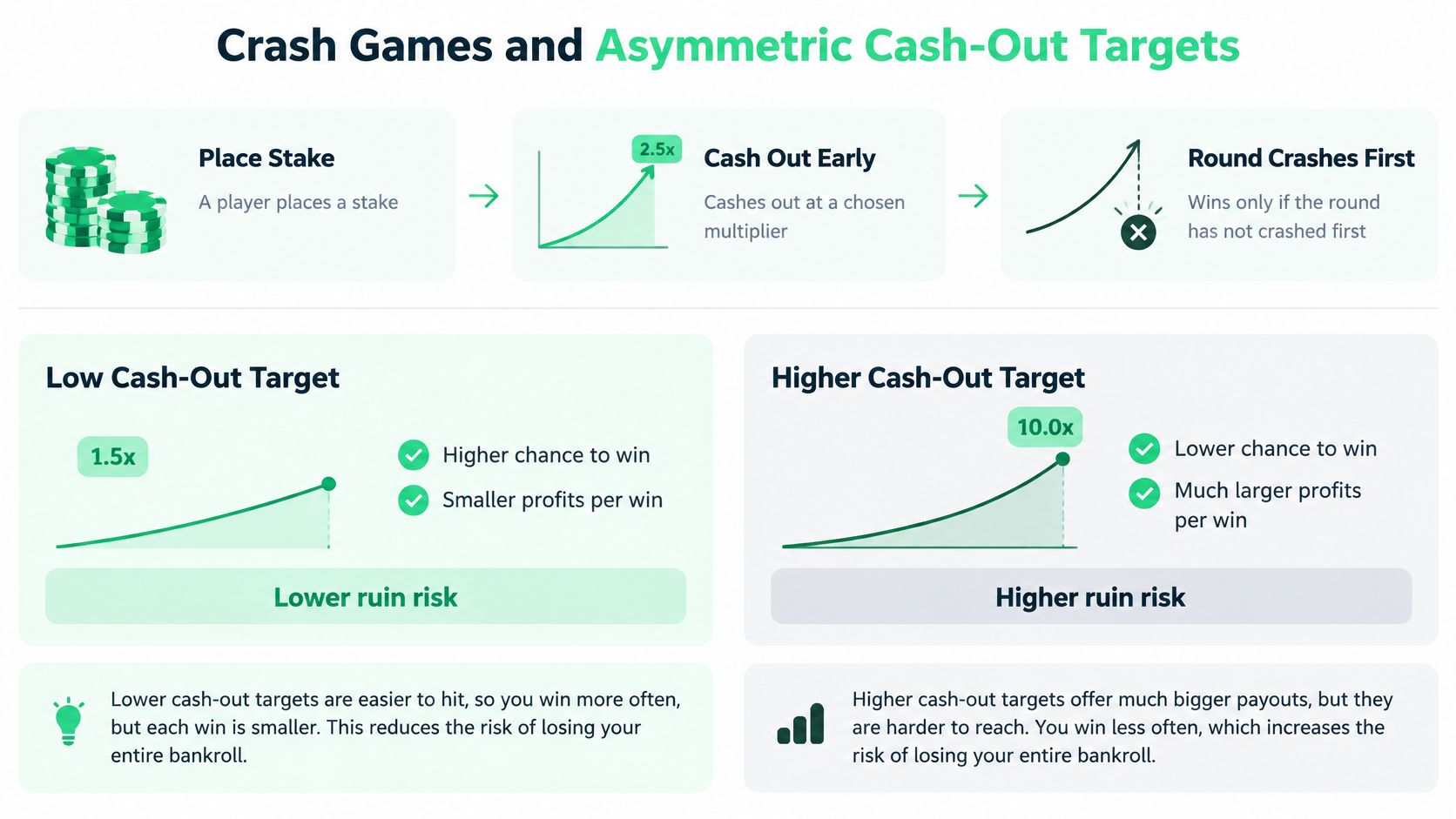
A 2025 economics working paper hosted by University College Dublin finds that, even with the same expected return, higher winning payoffs can produce higher ruin probabilities and lower average final wealth; ruin probabilities also converge faster in games with larger payoffs.
That finding explains why equal RTP doesn't imply equal bankroll survival. It doesn't establish a universal ranking of cash-out settings under every bankroll, target, or stopping rule.
Model the unequal steps
The classic even-money formula assumes matching upward and downward steps. A crash wager targeting a high multiplier instead combines a stake-sized loss with a much larger possible profit. Substituting its win chance into the equal-step formula would misrepresent the bankroll process.
A suitable simulation or state-based calculation should include:
- Payout mapping: The actual relationship between multiplier and probability.
- Stake policy: Fixed stakes or stakes proportional to the remaining balance.
- Stopping conditions: Loss floor, profit target, round limit, and treatment of a win that overshoots the target.
Automatic cash-out can make the selected threshold consistent, but it doesn't turn asymmetric payouts into even-money outcomes. Provider documentation should establish RTP, multiplier limits, and settlement rules before a model is treated as relevant to an actual game.
Ruin Odds Versus Real Financial Harm
A hypothetical 1,000-unit bankroll could consist entirely of rent money. Calling its ruin probability low wouldn't make the wager affordable. The same numerical risk attached to discretionary funds has a different household consequence.
A bankroll model records balances, not unpaid bills, borrowing costs, or the consequences of missing essential spending. Mathematical survival and financial safety are different tests.
Three outcomes deserve separate boundaries
- Bankroll ruin: The balance reaches zero or becomes too small for the next permitted stake.
- Loss-limit breach: Losses reach a predefined session or weekly allowance, even while funds remain available.
- Household-finance harm: Gambling compromises rent, bills, food, debt payments, or other necessary spending.
Australian gambling losses were approximately A$31.5 billion in 2022–23, an 18% increase from 2012–13, according to Australian data cited in the Deloitte Access Economics spending-limits study. Those aggregate figures describe financial losses, not a personal probability of ruin.
For an individual player, the relevant harm depends on disposable income, debt commitments, and whether the gambling funds were borrowed. A model that accepts a larger deposit as extra protection can conceal the fact that more essential money is now exposed.
Affordability rule: The boundary that matters is the amount a household can lose without compromising essential spending, not the amount an account can technically hold.
Practical limits should precede probability estimates
CrashRanked's responsible gambling guidance states that crash games can produce rapid losses. A workable safeguard is to exclude borrowed money, set the stopping point before the opening wager, and avoid replenishing a depleted allowance.
A loss limit isn't a recovery target. Continuing until earlier losses have been won back changes both the intended exposure and the stopping rule.
If gambling has already affected essential spending, the immediate task is to stop risking those funds and seek appropriate gambling-harm support. A more detailed ruin calculation doesn't resolve an affordability problem.
Common Misconceptions About Ruin Odds
A winning streak makes subsequent rounds safer. Under an independent-outcome model, earlier wins don't reduce the next round's loss probability. A higher current balance can change the distance from a boundary, but that's a bankroll change, not evidence of a favorable streak continuing.
Earlier crash multipliers reveal the next result. The UK Gambling Commission's remote gambling technical standards require demonstrably random outputs and guidance specifies computational unpredictability even when the algorithm and previous outputs are known. That supports treating past multipliers as outcomes, not a reliable forecasting signal.
Verification isn't protection from losses
Provably fair means financially favorable. A provably fair explainer describes a common commitment-and-reveal process using a server seed, client seed, and nonce. Verification checks whether a disclosed result followed the committed inputs and published algorithm; it doesn't establish favorable payout terms.
A reproducible check needs the revealed server seed, its earlier hash, the client seed, the correct nonce, and the derivation formula. Missing inputs should be treated as a verification gap rather than filled with assumptions.
Randomness and verification also don't establish an RTP, house edge, multiplier ceiling, or cash-out rule. Those are separate game-math and implementation questions.
RTP isn't a session-loss forecast
High RTP means a small loss in each session. RTP describes expected long-run gross return per unit wagered, not a promise about the ending balance of an individual session. Short-run outcomes depend on the payout distribution and the sequence of results.
The bankroll consequences of these misconceptions differ:
- Streak confidence can encourage an unjustified stake increase.
- Pattern prediction can turn random history into a reason to keep betting.
- Verification confidence can distract from unfavorable payout terms.
- RTP confusion can lead a player to budget for an average rather than a possible loss.
None of those beliefs adds funds to the bankroll or changes the documented rules.
Check Your Own Ruin Odds Before You Play
A useful assessment begins with written assumptions, not a calculator's default settings. The calculation should answer a specific question about a defined budget and stopping policy.
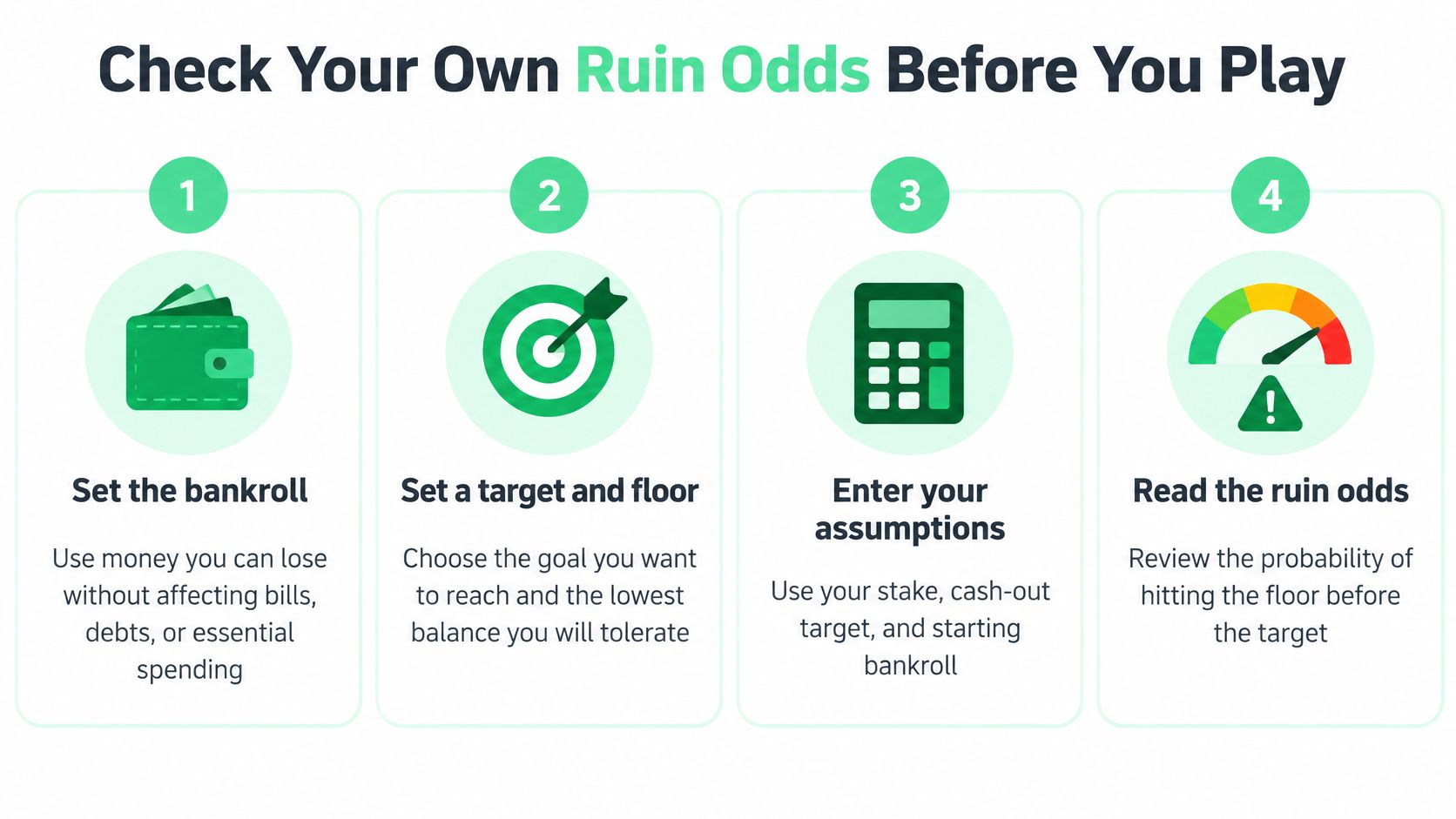
Define the discretionary bankroll. Only money available after bills, debt commitments, and essential spending belongs in the model. An account balance isn't automatically an affordable gambling budget.
Write down the target and floor. Both should use the same monetary unit. The lower boundary should reflect the intended stop, including any practical minimum-stake restriction.
Choose the stake policy. For fixed-stake analysis, divide the available bankroll by the stake to express the balance in bets. Proportional staking and changing stakes require their own calculations.
Identify the cash-out setting. An illustrative multiplier model can demonstrate the mechanism, but actual estimates should use documented game probabilities or a justified payout mapping. Unsupported inputs should remain explicitly uncertain.
Use a matching calculation. An even-money spreadsheet can use the biased gambler's ruin formula; an asymmetric crash wager needs a compatible simulation. CrashRanked publishes a Crash Glossary, Crash Calculator, Session Simulator, Crash RTP Index, Provably Fair Guide, Research Library, and Evidence Index; the Crash Calculator covers odds, wagering, and partial cash-out.
Specify separate loss and win stops. The loss boundary ends play rather than triggering a larger stake. Repeated-session analysis should state whether balances carry forward or each session receives newly committed funds.
Check the underlying documentation. RTP, maximum multiplier, payout caps, cash-out settlement, and provably fair inputs should match the version being modeled. A simulation cannot correct an inaccurate rule assumption.
Record assumptions alongside results
The written checklist should contain bankroll, floor, target, bet size, cash-out multiplier, loss limit, and win stop. Each numeric entry should carry a label identifying whether it is a personal model assumption or a documented game parameter.
The result should also identify whether it measures ruin before a target, ruin within a fixed session, or cumulative exposure across sessions. Without that label, an apparently precise percentage can answer the wrong question.
CrashRanked offers independent crash casino rankings, game mathematics, and fairness research for readers evaluating bankroll exposure. Adults can visit CrashRanked to compare documented game conditions and use its educational resources before deciding whether any proposed stake fits an affordable loss limit.