Random Number Generator Casino: How Fairness Testing Works
Learn how a random number generator casino works, what fairness testing checks, and how RNG certificates differ from provably fair verification.
A casino RNG is a tested algorithm designed to make each result unpredictable; certification covering both the generator and outcome mapping confirms those processes, not a player's return or a winning result. The popular advice to look for a certified badge is therefore incomplete: the badge matters only when its scope matches the game running.
For anyone researching a random number generator casino, the useful question isn't whether the numbers are random. It's whether the entire chain, from the initial value to the displayed crash multiplier, has credible evidence behind it.
Table of Contents
- What a Casino Random Number Generator Actually Does
- The Five Properties a Fair Casino RNG Must Have
- How a Random Number Becomes a Crash Multiplier
- How Independent Labs Test a Casino RNG
- RNG Certificates Versus Provably Fair Verification
- Streaks, Due Multipliers and Cash-Out Myths
- Confirm the RNG Evidence Before You Deposit
What a Casino Random Number Generator Actually Does
A random number generator, or RNG, produces values that shouldn't be predictable from earlier values. Game software then converts those values into something meaningful, such as a crash multiplier, a card, or a reel position.
A lottery drum provides a useful analogy. A credible draw requires more than balls tumbling convincingly: nobody should know which ball will fall next, and nobody should have loaded the drum to favor a particular result. The visible movement isn't proof of either condition.

Random values come before game results
The same distinction applies to software. A generator supplies a raw value, while the game's rules determine what that value means and what it pays. An unpredictable value doesn't automatically establish that the conversion is correct.
For U.S. Class II gaming systems, the federal RNG requirements require statistical randomness testing at a 99% confidence level and prohibit changing RNG processes or outcomes in response to prizes won in earlier games. That scope matters: these are requirements for a defined regulatory category, not a universal certificate for every online casino.
The confidence level describes a testing threshold. It doesn't mean a player has a corresponding chance of winning, and it isn't a promise that every short sequence will look balanced.
Practical rule: A random value is the beginning of a game result, not proof that the entire game is fair.
The prohibition on adapting outcomes to prize history also separates legitimate randomization from a system that merely looks unpredictable. A player's earlier wins shouldn't become a reason for the system to manufacture later losses.
An RNG certificate therefore supports the integrity of the randomization mechanism. It doesn't, by itself, guarantee an advertised return-to-player percentage, establish favorable betting conditions, or promise a favorable individual result.
The Five Properties a Fair Casino RNG Must Have
Five properties of a fair casino RNG and the evidence to request
| Property | What It Means | Evidence to Request |
|---|---|---|
| Statistical randomness | Output passes frequency and randomness tests | Named test battery, confidence level and test date |
| Unpredictability | The next output cannot be inferred from earlier outputs | Algorithm class and description of seed protection |
| Non-repetition | Output cycles and synchronized streams are prevented | Statement on cycle length and independence of RNG instances |
| Unbiased seeding | Seeds and reseeding do not introduce predictability | Seeding procedure and entropy source description |
| Correct mapping | Random values convert into the stated game probabilities | Multiplier formula, rounding rules, boundary handling and maximum multiplier |
These are separate checks, not interchangeable descriptions of randomness. The UK Gambling Commission's requirements for random outcomes address uniform output, computationally infeasible prediction, non-cycling and unsynchronized streams, safe seeding, and outcomes that follow theoretical probabilities.
What each property rules out
Statistical randomness concerns the distribution and behavior of sampled outputs. A sequence can look convincing to a player while failing a formal test, so useful evidence names the test battery, assessment threshold, and test date.
Unpredictability concerns what an observer can infer before the next result. A generator might produce balanced frequencies yet remain vulnerable if someone can reconstruct its internal state; the evidence should identify the algorithm class and explain how seeds and state are protected.
Non-repetition doesn't mean that an individual multiplier can never appear again. It means preventing problematic cycles or synchronized streams across generator instances, supported by documentation about stream independence and cycle behavior.
Unbiased seeding concerns the starting information and subsequent reseeding. A well-designed algorithm can still become predictable through weak initialization, so the relevant evidence describes the entropy source and seeding procedure.
Correct mapping concerns what happens after generation. Even well-distributed raw values can produce the wrong multiplier frequencies if the conversion formula compresses part of the outcome range; the evidence must cover the game mathematics.
A complete evidence request
A useful request combines the named test battery and date, tested software version, and confirmation that the report covers the live configuration. It also includes the multiplier formula, rounding rules, boundary handling, and maximum multiplier.
A generic statement that a platform uses secure randomness doesn't answer all those questions. Each property needs evidence at the layer where it could fail.
How a Random Number Becomes a Crash Multiplier
The UK Gambling Commission's remote technical standards require raw RNG output to be uniformly distributed across its range and mapped game outcomes to follow their theoretical probabilities. Transformations such as scaling must preserve the relevant properties rather than introduce bias.
The outcome pipeline makes those separate responsibilities easier to see.
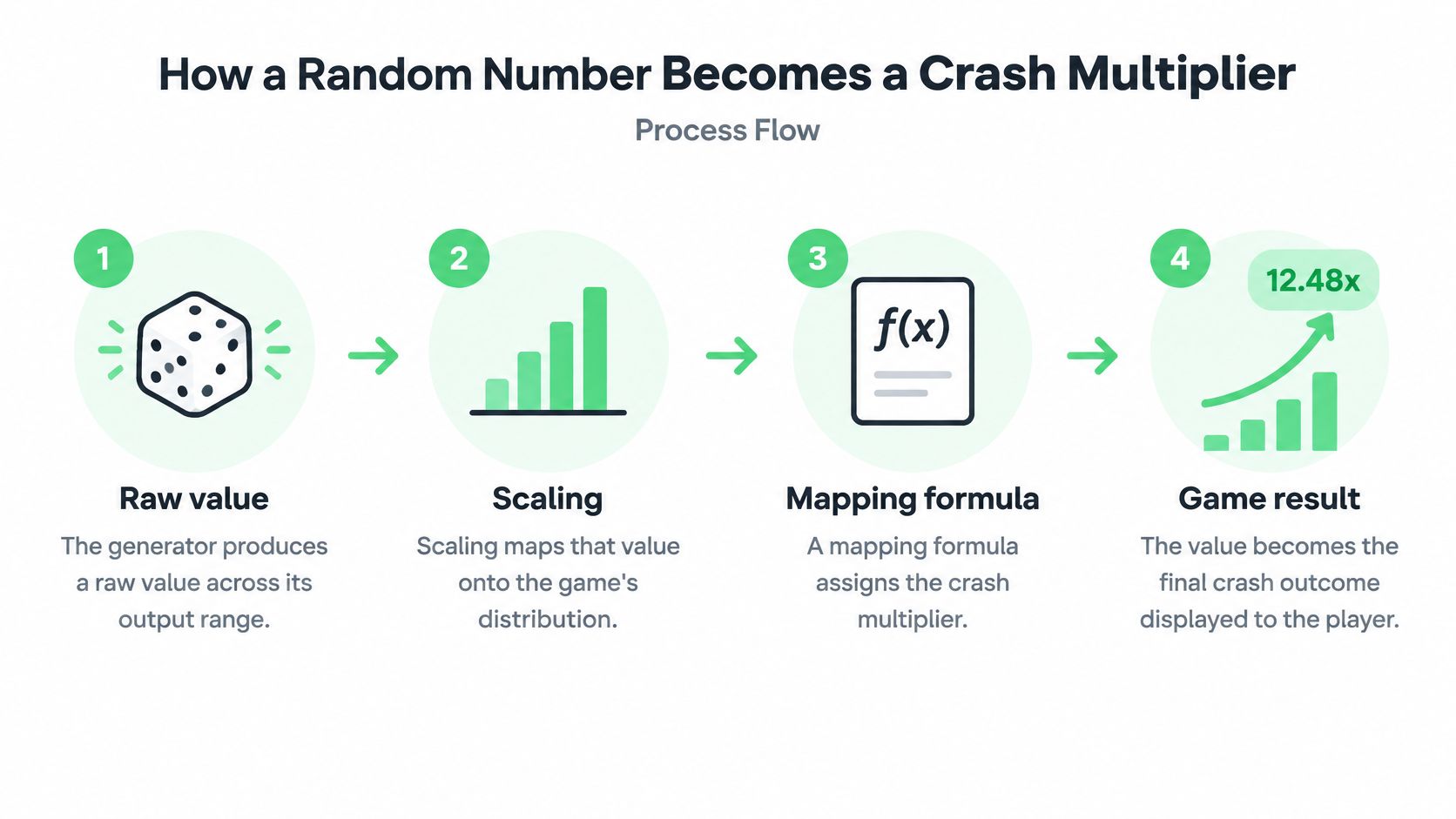
- Raw value. The generator produces a value across its output range; bias can enter if some values occur more frequently than the design allows.
- Scaling. Software maps that value onto the game's distribution; an incorrect transformation can give some intervals too much weight.
- Mapping formula. The game assigns a crash multiplier and applies any disclosed house-edge adjustment; an incorrect formula can change the expected payout distribution.
- Game result. Boundary handling, rounding, and maximum caps determine the final multiplier displayed and recorded; errors here can alter outcomes near thresholds or make the display inconsistent with settlement.
Why a passing generator isn't enough
Consider a rounding rule that caps displayed multipliers at a fixed ceiling. Every raw outcome the formula would have pushed above that ceiling gets pulled back down and recorded at the ceiling value instead. The raw generator still produces perfectly uniform output, so its test results stay clean, yet the ceiling multiplier now appears more often than the theoretical distribution predicts and the values just above it never appear at all.
Testing steps one and two alone won't catch that. The distortion lives in steps three and four, where a technically correct random number is reshaped into something the game's mathematics never intended.
The final multiplier needs its own evidence, not merely evidence about the numbers used to calculate it.
The crash-game probability formula explanation shows how a theoretical distribution is constructed, which gives you a reference point for checking a specific implementation. It shouldn't be used to assume that every crash title uses the same formula.
Distributional testing and mapping review are both necessary. A solid evidence request names the test applied to the raw output, then asks for the conversion formula, rounding rules, boundary handling, and maximum multiplier, so every link in the chain is covered rather than just the first one.
How Independent Labs Test a Casino RNG
A short sequence can look random while concealing bias. A screen full of varied results proves almost nothing, so independent laboratories work from large recorded samples and from the implementation details behind them.
Sampling works like quality control on a production line. One good unit tells you little, but thousands of units reveal a systematic flaw.
Testing benchmarks cited by regulators and technical standards
| Benchmark | Source | What It Establishes |
|---|---|---|
| A stated minimum sample of collected game outcomes | Gaming Laboratories International interactive-gaming standard | Sample sizes large enough to detect significant deviations from expected behavior |
| Chi-squared test over the most recent 10,000 outcomes | Nevada technical standard | Continuous monitoring against the game's mathematical model |
| Pre-release analysis of raw and scaled game data | UK Gambling Commission testing guidance | Satisfactory game and RNG reports before a game is made available |
What the tests establish
The collection benchmark addresses the sample-size problem directly. More observations let testers look for deviations that a brief sequence could hide, although a large sample never replaces review of the algorithm and implementation.
A chi-squared goodness-of-fit test compares how often each outcome occurred with how often the game's mathematical model predicts it should occur. Small gaps are ordinary noise. Large or persistent gaps demand an explanation, and the plausible causes include generator bias, a coding error, or a faulty conversion from random values to game outcomes.
The UK pre-release approach widens the scope of that review: approved third-party testing examines raw data and scaled or shuffled game data. Testing only the raw stream leaves the game's conversion logic insufficiently examined.
What a usable report identifies
A meaningful report identifies the RNG version, hardware or software implementation, digital signature, test scope, and methods applied. For a crash game, the evidence should connect that report to the specific configuration the casino offers.
A useful report describes the actual game variant, not only a generic platform. A recognizable laboratory name cannot close that gap on its own.
A report records an assessment at a particular point in time, so the test date and covered version matter as much as the lab's name. Ongoing monitoring and version control help surface problems introduced after release, including changes an older certificate could never have assessed.
RNG Certificates Versus Provably Fair Verification
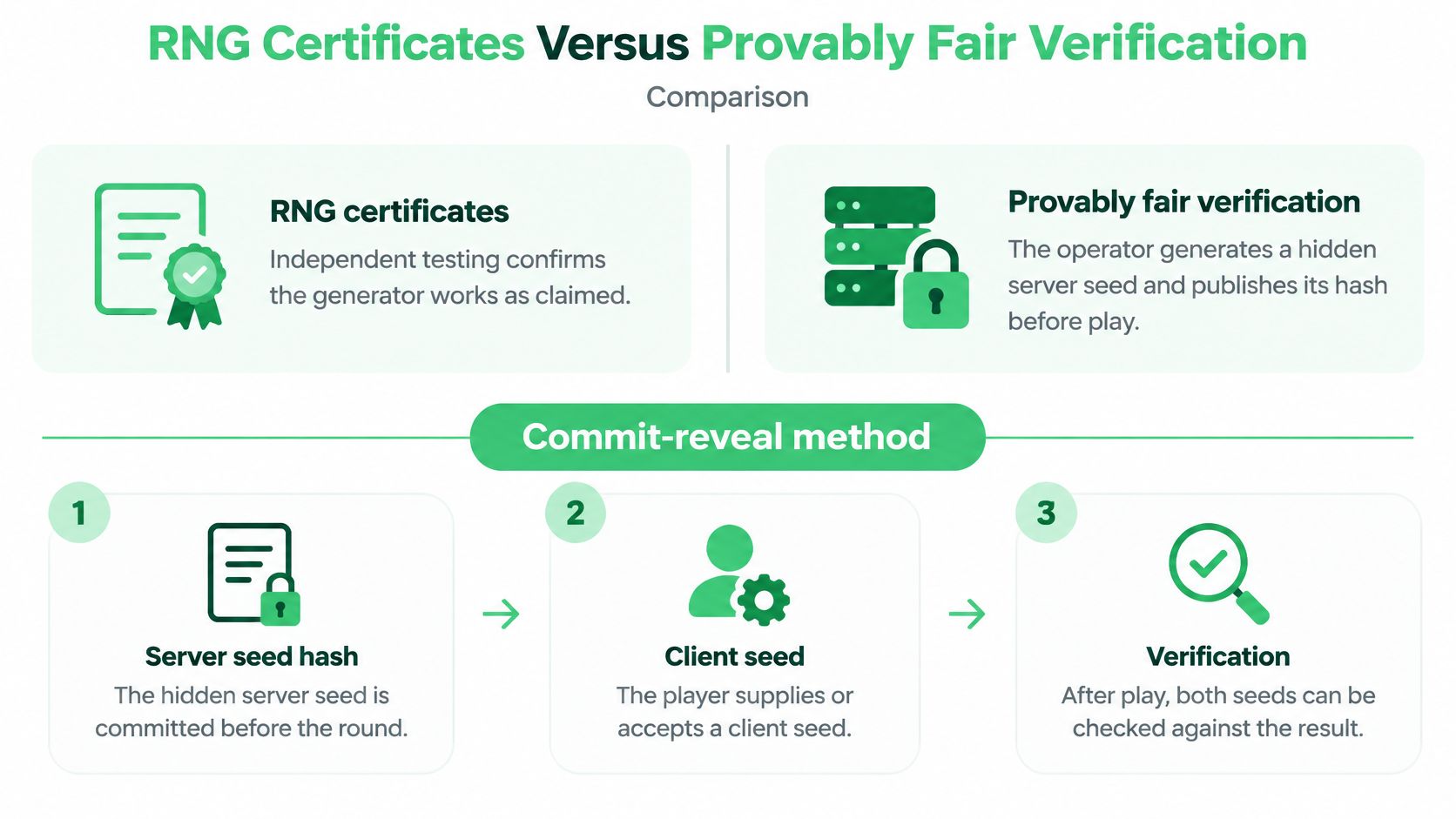
A certificate and a reproducible round answer different questions, so treating them as interchangeable is the first mistake to avoid. A laboratory certificate describes testing performed on a generator and its outcome mapping at a stated point in time. Provably fair verification runs in the other direction: it lets a player reconstruct one completed round after the fact and check it against inputs the operator committed to beforehand.
In the process described by CCN's provably fair guide, the operator publishes a hash of a hidden server seed before play, the player supplies or accepts a client seed, and a nonce advances for each round. After disclosure, the inputs can be used to reproduce the result. The commitment prevents the operator from swapping the seed once bets are placed, and the player's own client seed prevents the outcome from being fixed before the player acts.
What each verification method proves and what it leaves open
| Check | What It Proves | What It Does Not Prove |
|---|---|---|
| RNG certificate | The generator and outcome mapping passed lab tests at a stated point in time, when both are within scope | The live version matches the tested version, the advertised RTP is applied correctly, or withdrawals are paid |
| Provably fair verification | A specific round matched the committed server seed, client seed, nonce, and disclosed formula | Future results, a particular RTP, or a positive player return |
| Published RTP | The stated long-run expected return under the mathematical model | Independent proof of implementation or the outcome of a particular session |
Reproducing a completed round
A common implementation combines the inputs using HMAC-SHA256, the keyed-hash construction defined in the IETF's HMAC specification, to generate a 64-character hexadecimal output. The operator's exact input formatting and seed order decide whether the recreation matches the recorded round.
- Retrieve the inputs. Copy the revealed server seed from the completed round record, together with the client seed and nonce.
- Check the commitment. Hash the revealed seed with the disclosed algorithm, commonly SHA-256, and compare it with the hash published before play.
- Recreate the output. Combine the inputs using the disclosed method, commonly HMAC-SHA256.
- Calculate the multiplier. Apply the game's published mapping, including its rounding and boundary rules.
- Compare the result. Check the calculated multiplier against the recorded game result.
If the operator doesn't publish the mapping, verification stops at the cryptographic output. Checking a matching seed hash alone doesn't confirm the displayed multiplier.
The provably fair verification guide provides context for evaluating this process. A laboratory certificate and a reproducible round offer different evidence: one speaks to the tested build, the other to a specific played round, so neither substitutes for the other.
Verification can confirm that a losing result followed the disclosed process while the payout mapping still carries an operator margin. Result integrity and expected return are separate questions, and a verified round answers only the first one.
Streaks, Due Multipliers and Cash-Out Myths
What recent results cannot establish
Is a high multiplier due after a run of low ones?
Under a compliant, non-adaptive implementation, each round starts fresh and earlier losses create no entitlement to a later high result. A history panel shows completed outcomes, nothing more. Reading it as a repayment schedule working toward a balance is the classic misread.
The explanation of whether crash rounds are independent addresses that distinction. A run of low results can feel like a pattern forming, yet it supplies no betting advantage.
Does auto cash-out at a chosen target improve the game's built-in return?
Auto cash-out automates an exit instruction, subject to the game's execution rules. The target still has to be reached before the crash, and the underlying probability model stays the same whatever the setting.
For example, 96% RTP implies a 4% mathematical house edge when RTP represents long-run expected player return, as explained by the Evening Standard's house-edge guide. Individual sessions can depart substantially from that expectation, while no betting sequence or cash-out setting removes the built-in margin.
What badges and displays cannot establish
Does a provably fair badge mean positive expected value?
Treat the badge as a scope statement. It tells you that rounds can be checked against a disclosed process, so read it as a claim about auditability. Whether the deal is favorable is a separate question, answered by the RTP figure and the payout mapping behind the display.
A badge answers a narrow question: can this result be checked? The generosity of the payouts sits outside its scope.
Does a varied run of multipliers prove the mapping is fair?
A display can mix small, medium and large results convincingly while diverging from the advertised distribution. Confirming a match requires the published mathematics and the live implementation, since recent rounds only ever show a thin slice of the full distribution. An impression formed from a session or two is the weakest evidence on the page.
CrashRanked is marked 18+, and its responsible-gambling guidance warns that crash games can produce rapid losses. Those cautions apply whether a game uses conventional certification or player-verifiable results.
Adult players who choose to play should set a budget and a time limit beforehand, never chase losses, and never wager borrowed money.
Confirm the RNG Evidence Before You Deposit
The strongest assessment follows the evidence from the operator's identity through to the live game and its withdrawal terms. The UK Gambling Commission's RNG guidance provides regulatory context, but a technical badge shouldn't be stretched into an assurance about every aspect of a casino.

A pre-deposit evidence checklist
- Confirm the operator's licence and named regulator, because a logo or certificate from an unidentified authority provides little basis for assessing accountability.
- Identify the testing laboratory, report date, and scope, because a badge without a traceable assessment doesn't establish what anyone examined.
- Match the exact game and live software version, because a certificate for an earlier build or another variant doesn't automatically cover the current implementation.
- Confirm coverage of raw output and multiplier mapping, because an assessment of the generator alone leaves the conversion into payouts unverified.
- Locate the commitment, client seed, nonce, and published formula for a provably fair game, then reproduce a completed round to establish whether verification is possible.
- Compare the advertised RTP with the game provider's documentation, because a promotional percentage needs a defined mathematical basis and an identifiable game configuration.
- Examine identity-verification and withdrawal terms, because technical fairness doesn't establish when documents are required or whether payment restrictions could block a withdrawal.
Red flags that leave the chain incomplete
Missing laboratory names, seed hashes that cannot be checked, undocumented RTP claims, and unavailable multiplier formulas all leave specific questions unanswered. None becomes less important because the game has polished graphics or accepts cryptocurrency.
The same discipline applies when comparing Aviator, JetX, Spaceman, Aviatrix, Chicken Road, or other crash-style titles. A familiar game name shouldn't be treated as evidence that every casino offers the same version, configuration, or account terms.
CrashRanked reviews crash games, withdrawal records, KYC claims, and offer terms before publishing a score. Some casino links are affiliate links, and CrashRanked may earn a commission at no additional cost to the reader.
For further checking, CrashRanked publishes a Provably Fair Guide, Crash Glossary, Crash RTP Index, Crash Calculator, Session Simulator, Research Library, and Evidence Index. Its crash casino rankings provide a comparison starting point, while the verification resources and probability tools support examination of the claims behind a listing.
Unresolved evidence gaps are a reason to pause, not a reason to deposit first and investigate later. Gambling should involve only money the adult player can afford to lose.
CrashRanked offers crash casino comparisons, fairness research, and educational resources for assessing the evidence behind RNG claims. Visit the site to compare game documentation, verification methods, KYC policies, and withdrawal evidence before choosing an operator.