Wagering Requirements Explained: How Bonus Turnover Works
Wagering requirements explained with worked examples: how multipliers, contribution rates, deadlines and bonus terms affect when you can withdraw.
Required wagering equals the bonus amount multiplied by the stated multiplier, so a £10 bonus at 50x requires £500 in qualifying bets before bonus-related funds become withdrawable. That calculation applies to a bonus-only offer, not necessarily to an offer that includes the deposit in its calculation.
The headline multiplier leaves important questions unanswered. Readers looking for wagering requirements explained need to separate required turnover, the expected cost of generating it, and the funds restricted from withdrawal. A promotion can look manageable on the first measure and prove unsuitable on the others.
Table of Contents
- Required Wagering in Worked Examples
- What a Wagering Requirement Actually Measures
- Which Part of Your Balance Is Locked
- Checking Contribution, Stake Limits and Deadlines
- Why a Lower Multiplier Can Still Cost More
- Decide Whether a Bonus Is Worth Claiming
Required Wagering in Worked Examples
A multiplier becomes meaningful only after it is converted into account currency. The base matters first: a bonus-only formula uses the promotional amount, while a deposit-plus-bonus formula uses a larger base before the multiplier is applied.
Two offers can share the same headline multiplier and still demand different turnover. The worked examples below separate the arithmetic from the restrictions that still need checking.
Required wagering for common bonus formulas
| Bonus Formula | Bonus or Base Amount | Required Wagering | Note |
|---|---|---|---|
| 50x bonus only | £50 bonus | £2,500 | Supplies the pre-cap comparison figure used below |
| 10x bonus only | £75 bonus | £750 | The worked calculation behind the Swansea study |
| 10x UK cap from 19 January 2026 | £50 bonus | £500, compared with £2,500 at 50x | British incentive-rule ceiling; other markets can differ |
| 10x bonus only | $20 bonus | $200 | Same multiplier, smaller base amount |
| 20x bonus only | $100 bonus | $2,000 | Doubling the multiplier doubles the turnover target |
These figures describe cumulative qualifying bets that can be placed over time. They show required turnover only; the locked balance and the expected cost of clearing it remain separate checks.
Why the currency calculation matters
In a 2026 study of 585 UK bettors recorded by Swansea University, participants shown an inducement without a worked calculation estimated median required wagering of £500, compared with the correct £750. The correct requirement was therefore 50% higher than their median estimate.
That distinction matters because describing the estimate itself as a 50% underestimate would use the wrong denominator. The practical finding is simpler than the statistical terminology: participants substantially understated the betting obligation when the offer lacked a worked calculation.
The study also found that showing a worked example reduced mistaken perceptions of the inducement's attractiveness. A multiplier alone communicates less than a concrete amount in the player's account currency.
Practical rule: Calculate the total in money before considering whether the bonus is worth accepting.
A legal cap on the multiplier leaves eligible-game rules, maximum stakes, expiry dates and withdrawal conditions untouched. Readers outside Britain should also check which rulebook applies to their own account.
When reviewing bonus terms and wagering offers, the useful comparison is the complete calculation: the stated base, the multiplier and the resulting qualifying turnover. If the operator's displayed target differs from that calculation, resolve the discrepancy before acceptance.
What a Wagering Requirement Actually Measures
A wagering requirement is the total amount that must be bet before bonus-related funds become withdrawable, usually expressed as a multiple of the bonus, the deposit or both. It measures betting turnover, not the outcome of the session.
A qualifying stake contributes toward the target even when the bet loses. A winning bet can return funds that are subsequently wagered again, so cumulative turnover can exceed the balance originally available. Neither outcome makes completion certain.
Turnover isn't the same as loss
The distinction resembles a distance-based toll road. A fast journey and a slow journey incur the same distance charge if both cover the same route; travelling faster doesn't shorten the measured distance.
For wagering, the measured quantity is eligible stakes rather than distance. The analogy stops at cost: gambling losses aren't a fixed toll, because individual outcomes vary and the balance may run out before the target is reached.
The Gambling Commission's rewards-and-bonuses code requires British licensed operators to present incentive terms clearly, transparently, fairly and accessibly, and sets a maximum wagering requirement of 10 times the incentive amount from 19 January 2026. That cap limits the incentive's wagering burden, but doesn't make every permitted promotion equally suitable.
The process diagram separates receiving promotional funds from becoming eligible to withdraw them.
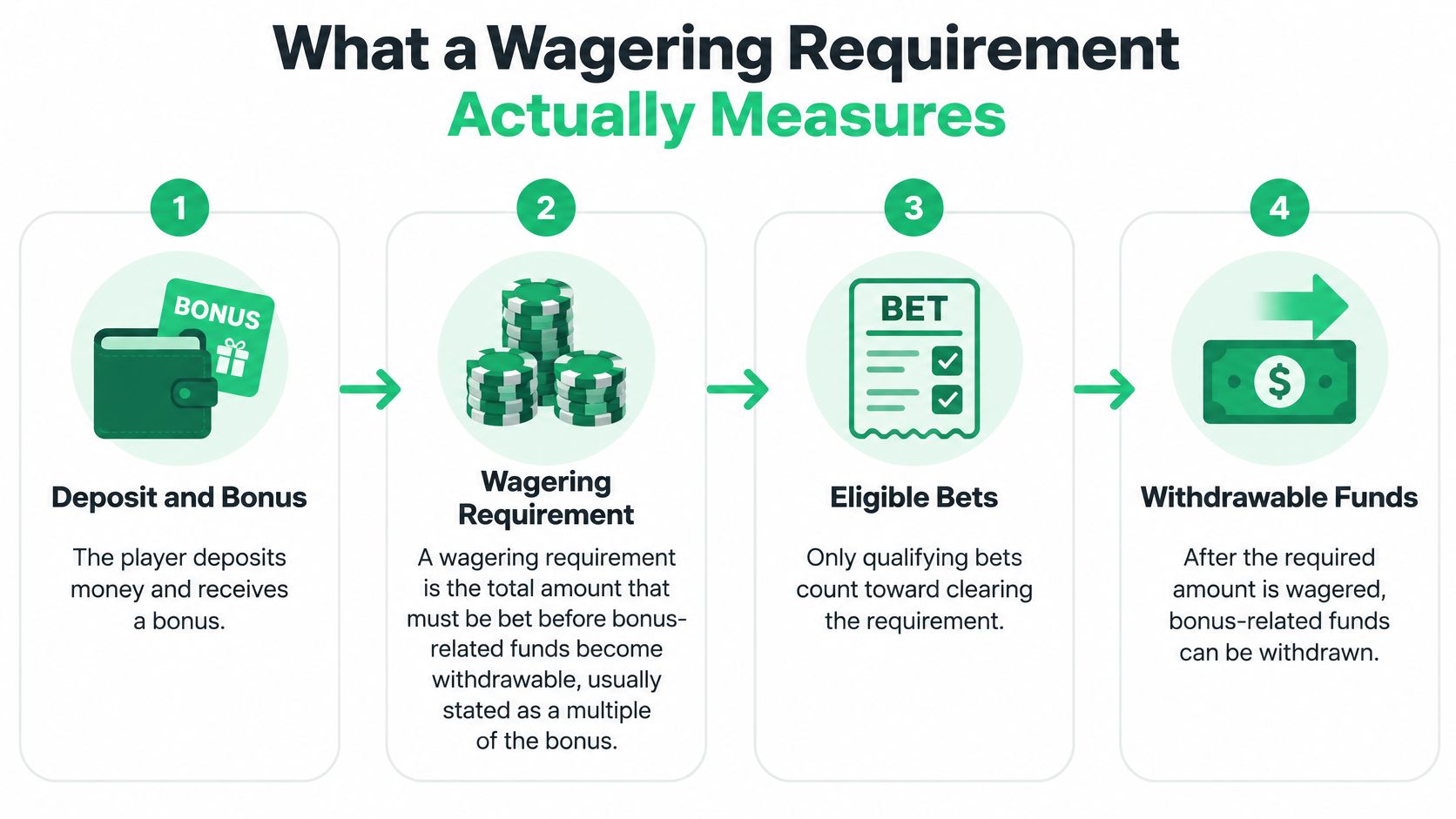
What completion involves
- Receive the bonus. The player accepts the promotion and establishes which terms apply.
- Place qualifying bets. Only activity allowed by those terms contributes.
- Track eligible turnover. The account's progress counter should reflect credited wagering, not all money staked.
- Meet the remaining conditions. Completing turnover doesn't excuse an excluded-game or maximum-stake breach.
- Request the funds. Withdrawal remains subject to applicable account and payment checks.
The regulatory distinction is whether a specified total value of wagers must be completed before withdrawal. An ordinary gameplay condition, such as selecting an available betting option, isn't automatically a wagering requirement.
A player's chance of finishing depends on the game's house edge, volatility, stake limits, eligibility rules and deadline. Reaching the turnover target is a condition of withdrawal, not evidence that the session was profitable. A completed progress bar can coexist with a smaller remaining balance.
Which Part of Your Balance Is Locked
Suppose a player deposits $100, receives a $100 bonus and later sees $180 in the account. That displayed total alone doesn't reveal how much is cash, how much is bonus credit or which winnings came from each balance.
The Gambling Commission's guidance on withdrawing deposits and deposit winnings distinguishes bonus wagering from own-funds withdrawals: operators may impose wagering on bonus winnings, but must allow withdrawal of winnings made with a customer's own funds regardless of how much they have played. This is a British regulatory position, not a universal rule for every jurisdiction.
A combined account balance therefore isn't enough to establish withdrawal rights. The account ledger, promotional terms and applicable jurisdiction matter more than the headline total.
Cashable and sticky bonuses
A cashable bonus can become withdrawable when the stated conditions are satisfied. A sticky bonus generally remains promotional credit rather than becoming directly withdrawable cash, even where qualifying winnings can be withdrawn.
The distinction affects what remains after completion. Clearing a sticky promotion doesn't necessarily convert the original bonus credit into money belonging to the player.
Account interfaces can make these categories difficult to distinguish, especially when promotional and cash funds appear together.

Questions the terms should answer
- Is the bonus cashable? The terms should explain whether the promotional principal converts to cash or is removed when the promotion ends.
- Does the deposit form part of the calculation? This identifies the wagering base, but doesn't by itself establish that every fund in the account can be restricted.
- What happens on withdrawal? Requesting cash may cancel an unfinished promotion and remove bonus funds or associated winnings under the applicable terms.
Forfeiture means removing funds that the player no longer qualifies to retain under the promotion. Expiry, cancellation or a rule breach can trigger it; removal of a sticky bonus at completion is a separate treatment that should also be disclosed.
Before accepting, the player needs a clear account of cash balance, bonus balance, fund-use order and cancellation consequences. If the terms don't identify those categories, the displayed balance shouldn't be treated as fully withdrawable.
Checking Contribution, Stake Limits and Deadlines
Consider a hypothetical game with 100% contribution: every pound staked counts toward wagering. At 10% contribution, only £10 of every £100 staked counts, so clearing a £500 qualifying requirement would require £5,000 in actual stakes on that game.
An excluded game contributes nothing. Winning on it doesn't necessarily move the progress counter, and playing it with promotional funds may breach the offer rather than merely fail to contribute.
Calculate actual stakes before accepting
The useful formula is actual stakes needed = qualifying wagering target ÷ contribution rate expressed as a decimal. The result describes turnover, not the funds required to survive every possible sequence of outcomes.
The terms should also identify whether the progress calculation uses stakes or another stated measure. A payout isn't interchangeable with a stake: it may include returned stake as well as winnings.
For crash-style games, eligibility needs checking at title level. A casino offering a game doesn't automatically include that game in its promotion, and a provider-wide exclusion may override a broad claim that casino games qualify.
A pre-claim checklist
Identify the calculation base. Locate whether the multiplier applies to bonus funds, deposited funds or their combined value. The promotional headline isn't sufficient if the detailed terms define a different base.
Check the contribution of the intended game. Confirm the exact crash title and any provider exclusions. Switching to an unfamiliar eligible game to complete a promotion changes the risk the player originally intended to take.
Record the maximum permitted stake. Keep each bet within the promotional limit, including any rule covering combined or simultaneous bets. Depending on the terms, a breach may invalidate the bonus or associated winnings rather than merely exclude that wager from progress.
Write down the expiry deadline. In a hypothetical offer requiring £750 over seven days, the arithmetic works out to about £107 of qualifying wagering per day. That figure is a feasibility check, not a daily betting recommendation or a reason to continue after reaching a loss limit.
Read the cashout restrictions. A maximum bonus withdrawal can limit what the player retains even after successful completion. Check whether a separate time limit applies to requesting the withdrawal.
Identify verification requirements. Review when identity documents may be requested, which payment methods are eligible and whether any currency-conversion conditions apply. Cryptocurrency payments don't, by themselves, settle those questions.
An expiry date isn't a reason to increase stakes. If completion requires uncomfortable spending or rushed play, declining the promotion is the more useful decision.
CrashRanked's Bonus Fairness score weighs wagering requirements, maximum cashout caps and time limits. Before publishing a score, CrashRanked reviews crash games, withdrawal records, KYC claims and offer terms, rather than treating a promotional headline as sufficient evidence.
Individual casino reviews can help compare how operators disclose these restrictions. The crash bonus wagering contribution guide provides relevant context for checking whether intended crash-game play counts.
Why a Lower Multiplier Can Still Cost More
Expected loss equals actual turnover multiplied by the house edge, under a simplified model with a constant edge. For fully contributing play, the qualifying requirement and actual turnover are the same. Partial contribution raises the stakes needed to reach the target: if only half of each stake counts, the balance must turn over twice the stated amount, and the expected loss rises in step.
The Gambling Commission's discussion of wagering-requirement reforms addresses consumers' difficulty estimating promotional value. The arithmetic below shows where that difficulty starts. The multiplier printed in an offer fixes the required turnover, while the edge applied to that turnover is what prices it.
Expected cost at illustrative house edges
These are hypothetical calculations, not RTP or house-edge claims for any particular crash game. The table assumes full contribution and that the stated turnover is completed.
| Required Wagering | Expected Loss at 2% Edge | Expected Loss at 5% Edge | Expected Loss at 10% Edge |
|---|---|---|---|
| $200 | $4 | $10 | $20 |
| $2,000 | $40 | $100 | $200 |
| £750 | £15 | £37.50 | £75 |
Each cell is a long-run mathematical average, the expected cost of repeating the same play many times over. A single session can finish well above or well below it. The average sets no ceiling on losses and gives no guarantee that the balance lasts to the end of the wagering.
Compare the whole obligation
A lower-multiplier promotion can still be the costlier one. If it counts the deposit in its calculation base, gives the intended game limited contribution and expires quickly, it can demand more real betting than a higher-multiplier offer applied to the bonus alone at full contribution.
Four inputs decide the comparison: the actual turnover, the applicable house edge, the balance forfeited if the deadline passes and the amount that can ultimately be withdrawn.
A promotion's economic value can't be read from its multiplier alone.
Variance describes how far individual outcomes can depart from the average. A player may exhaust the available balance early or finish with a positive result; neither outcome contradicts a negative expected return.
CrashRanked warns that crash games can produce rapid losses. Auto cash-out can set an exit instruction in advance, but it doesn't make outcomes predictable or establish a guaranteed way to clear wagering. Provably fair verification lets the player check completed rounds; it offers no forecast for the rounds still to come.
The multiplier sets the size of the task. The base, the contribution rate and the edge decide what finishing it is likely to cost.
Decide Whether a Bonus Is Worth Claiming
The decision rests on three figures a player can work out before depositing: the turnover the bonus demands, the expected cost of clearing it at the game's house edge, and the portion of the balance locked until the requirement is met. When any of the three stays unknown, the offer has not been priced yet.
A large turnover figure measures required betting, not spending capacity. The relevant question is how much money the player is prepared to lose while attempting it, without replenishing the account to rescue an unfinished promotion.
Tests to run before accepting
- Set the loss limit first. Decide the maximum loss at your planned session stakes, and treat reaching it as the end of the attempt rather than a reason to redeposit.
- Map the locked balance. Confirm whether the deposit, the bonus, the winnings or all three are tied up, and what each becomes if you withdraw early or let the deadline pass.
- Check the deadline against your pace. An expiry that forces bigger or faster bets raises the cost of clearing the same requirement.
- Restate the terms plainly. If the calculation base, eligible games and treatment of remaining funds cannot be explained back, the offer is not yet understood.
The Crash Calculator turns those checks into numbers, modelling the odds, wagering and partial cash-out of a planned stake schedule before any money is committed.
Some casino links on the site are affiliate links, and CrashRanked may earn a commission at no additional cost to the reader. That disclosure does not replace examination of each operator's current terms.
CrashRanked is marked 18+. Its responsible gambling guidance covers setting a loss limit before play, never borrowing to meet a requirement and stopping when gambling stops being enjoyable.
CrashRanked publishes independent crash casino comparisons, game mathematics and fairness research to help readers assess more than a bonus headline. Visit CrashRanked to compare wagering restrictions, withdrawal evidence and verification terms before deciding whether any promotion fits an affordable gambling budget.